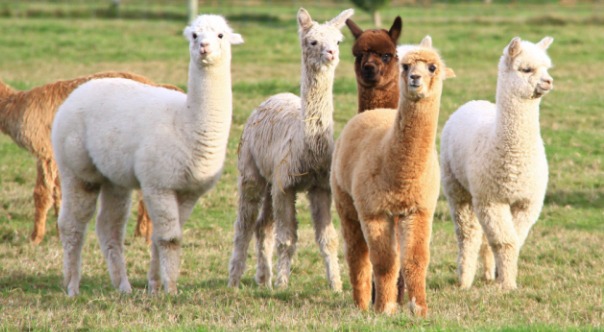
Alpacas are members of the camelid family, and so are related to camels, llamas, vicunas, and guanacos (vicunas and guanacos are wild, whereas llamas and alpacas have always been domesticated).American Alpacas came from the hills of South America, specifically, Bolivia, Chile, and Peru Baby alpacas and llamas are called crias (CREE-ahs), and weigh approx. 20-22 lbs at birth. Alpacas almost always have single births, and the gestation period for an alpaca is 11 1/2 months.
A full-grown alpaca weighs about 250-300 pounds and lives approx. 20-25 years. Alpacas are very quiet animals. They communicate primarily with body language, and soft humming sounds. Male alpacas make a “clucking” noise when they think a female is nearby, and a louder “alarm call” to alert the herd when they feel threatened. Alpacas only have teeth on the bottom in the front, the top is just a rubbery pallet.
This makes it very safe when feeding alpaca treats as they tend to take them with their soft lips! (They do have molars on top and bottom in the back to chew up their food.) Alpaca are often used as guard animals to protect sheep and goats from coyotes. One alpaca in the pasture will “bond” with the sheep or goats and charge a coyote head first to chase them away. If they catch the coyote, they will roll them with their head, and try to trample them with their front feet. Not all alpaca make good guard animals, so make sure the seller will allow a return, or exchange if the alpaca isn’t performing. The alpaca's large eyes can look in different directions independently from one another, and can see far distances- they are always watching for predators. When petting an alpaca head, do not put your hand up in front of their eyes or they will jerk their head back, always reach around and come up from the back.
The soft padded foot of the alpaca makes them environmentally friendly and excellent companions for packing and day hikes. All camelids do “spit” as a means of defense, and to show dominance within the herd. This trait is often exploited in movies and television and causes many people to be fearful of approaching llamas in a public setting. Although many alpacas in pastures or petting zoos have not been socialized to behave themselves properly among humans, most of the alpacas that are shown in parades, and at your local fairs, have been extensively trained by their handlers to not spit at people. The luxurious hair of an alpaca has a hollow core, and so is lighter weight for the warmth it provides. Alpaca fiber can be spun to make beautiful clothing and blankets and is hypo-allergenic. Most show llamas are shorn in the spring in a “barrel-cut” style to maintain their beauty for public events. This cut also helps to keep the llama cool during the warm summer months. Alpacas eat about one-third of what a horse would eat.
After grazing in the pasture most of the day, we usually give them a flake of local or eastern grass hay per animal (alfalfa hay is too rich for an alpaca's stomach). We also have a sandy “free-choice” mineral supplement available which provides the additional selenium and other vitamins essential to maintaining good health. Alpacas are “communal poopers”- they all tend to eliminate in the same location, which is very helpful when walking in the pasture! Their droppings look like black jelly beans, and because alpacas have three chambers in their stomach, their food is very well-digested and makes an excellent fertilizer for all types of plants. Alpacas are very intelligent and can be trained using a “click and reward” system to learn many fun tricks, and also respond to verbal cues.
Alpaca carts have been used for many special occasions, such as weddings, military retirements, and parades. Show alpacas are trained for competition in wool and confirmation classes, as well as a variety of performance and obstacle course classes. Many people travel the country with their alpacas for these competitions to increase their value and for breeding.
How much do you know about Alpacas? Here are some interesting facts to expand your knowledge and appreciation of these amazing creatures: